A First Visit to an Unfamiliar Community Room
A first visit to an unfamiliar community room becomes easier when you notice the entrance, shared cues and small points where newcomers may pause.
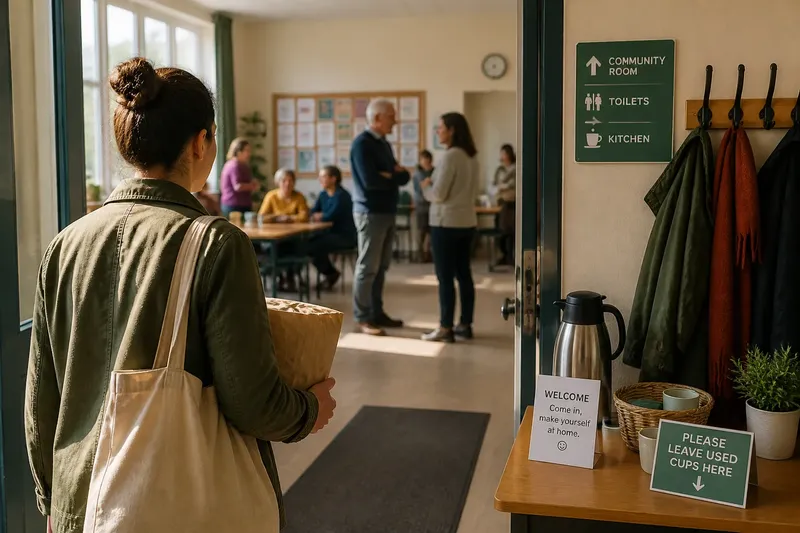
You arrive at a community room with a paper bag in one hand and no clear sign of which door to use. A first visit to an unfamiliar community room is often less about finding a seat than reading the small signals that regular users no longer notice. A calm visit can reveal where those signals help, and where a newcomer might stop to work them out.
These observations are useful whether you have come to attend a class, join a neighborhood meeting or help care for the space. You do not need to inspect the room like an auditor. Notice what you can see, what you have to infer, and what would make the next person feel less unsure.
1. Start observing before you reach the door
Notice how the room announces itself from the sidewalk, hallway or shared building entrance. A sign may give the room’s name but omit its floor, entrance or open hours. A lit window, an open gate or voices from inside can offer clues, though those clues may not be reliable for every visit.
Pay attention to what a person can know without asking someone else. Is there a direction sign at the point where paths split? Does the building have several similar doors? Are room names printed at eye level, or tucked near a handle? This is not a verdict on the place. It is a way to see how much local knowledge the arrival assumes.
2. Follow the entrance as a newcomer would
When you reach the building, pause long enough to identify the likely public entrance. Look for a doorbell, posted hours, a sign-in note or a visible person who can help. If the entrance is locked, check for a stated alternative rather than trying doors at random. The aim is to understand the expected way in, not to test access controls.
Once inside, notice whether the route to the community room remains legible. A corridor may lead past storage rooms, other groups or several unlabeled doors. Ask yourself where you would turn if nobody were waiting to greet you. If you do need to ask, note the point where the question became necessary; that is often the most useful observation.
3. Read the room’s shared cues
Rooms develop habits that are obvious to regulars: coats go on a row of hooks, cups are collected near a sink, and chairs are moved back after a gathering. These customs may be conveyed by a short sign, a familiar arrangement or a quick greeting. A newcomer can miss them without doing anything wrong.
Look for cues that explain what to do and what is optional. A labeled tray can show where to leave donated materials; a sign beside a kettle can clarify whether refreshments are self-serve. Notice whether instructions are readable from where the decision occurs. A general notice on a distant wall may not help someone standing at the table with a box in their hands.
Also notice what the room leaves unsaid. If everyone seems to know where to sit, you might hesitate over whether a table is reserved or whether chairs can be moved. That pause matters more than whether the room looks orderly. The question is whether its shared conventions can be learned without embarrassment.
4. Watch for the moment a visitor might hesitate
Hesitation often happens at a choice point: a person reaches the doorway and cannot tell whether to enter, sees a circle of chairs and does not know where to join, or finds supplies but cannot tell whether they are for public use. Keep the observation specific. “The room is confusing” is hard to act on; “the coat hooks are around a corner with no cue from the entrance” points to a possible adjustment.
Imagine you arrive carrying a plate for a potluck and see two tables, one covered with food and one with papers. You might pause because there is no clear place for incoming dishes. A small, movable card reading “Food for sharing” could make the expected action visible. The useful result to look for is simple: a visitor can choose a table without interrupting the gathering to ask.
It is not worth the effort to catalog every chair, scuff or decoration during a first visit. Focus on moments that affect arrival, participation or putting things away. Cosmetic preferences can wait unless they obscure a sign or make a shared cue difficult to see.
5. Notice how people make room for one another
A community room is shaped by its users, not only by its furniture. Watch how people greet someone who arrives late, make space for a mobility aid, or explain an unfamiliar routine. These small interactions show whether a newcomer is expected to figure things out alone or can ask a question without feeling in the way.
Do not treat one encounter as a complete picture. A quiet meeting may have different habits from a busy children’s program, and the person at the door may be new too. If you visit for a specific activity, consider which cues belong to that gathering and which seem to apply to the room itself.
6. Leave with one useful observation
After the visit, record one or two points while they are fresh. Separate what you directly saw from what you guessed. “There was no sign at the hallway turn” is an observation; “people do not feel welcome” is an interpretation that would need more context.
If you are part of the group that uses the room, share a specific suggestion with the person responsible for signs or setup. Keep the proposal modest and easy to consider: add a directional arrow at the corridor fork, or place a welcome note where visitors first enter. If you are a guest, ask whether the group welcomes feedback before proposing changes.
What should you look for on a first visit?
How can you tell which entrance visitors should use?
Look for a sign, posted hours, a doorbell or a person visibly welcoming arrivals. If the expected entrance remains unclear, ask rather than trying a sequence of doors.
What shared cues are useful to notice?
Notice where people put coats, supplies and used dishes, and whether signs or greetings explain those routines. The most useful cues appear near the place where someone must act.
How should you record a point of confusion?
Describe the place and the choice a visitor faced, without assuming why it happened. For example, note that two unmarked doors sit beside the room sign and a guest may not know which one to try.
What can a newcomer suggest without overstepping?
Offer one specific, low-effort idea and ask who is responsible for decisions about the room. The group can decide whether it fits its routines and the needs of its users.
A first visit to an unfamiliar community room can be useful even when nothing needs changing. The clearest contribution may be a small observation made at the right moment: where a sign would help, where a custom needs explaining, or where a visitor could be greeted before uncertainty turns into a reason to leave.