Why a Clear Route Changes the Feel of a Shared Room
A clear route through a shared room makes movement easier to read, helps activities find their place, and lets people join in without disrupting others.
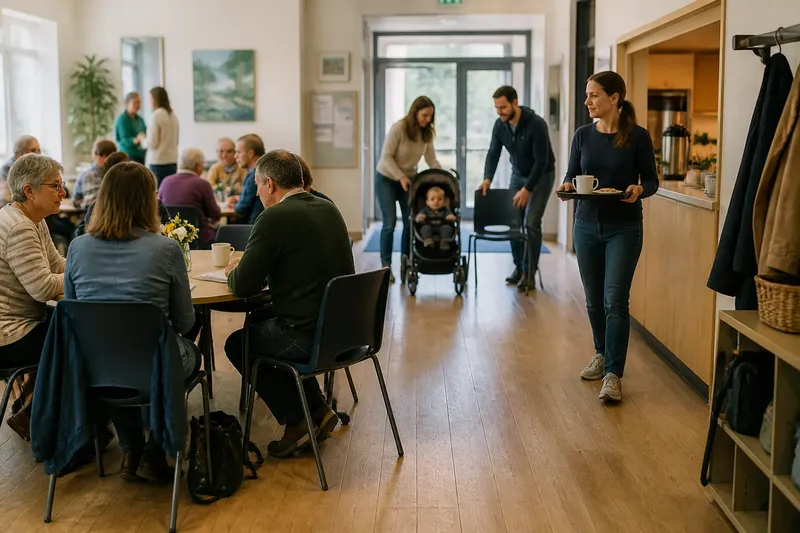
In a community room, someone carrying a tray pauses beside a table while two people shift their chairs to let a stroller pass. A clear route through a shared room can prevent that small negotiation from becoming the room’s usual rhythm. When people can see where to walk, where to pause, and where activities belong, the space feels easier to share.
What counts as a clear route through a shared room?
A clear route is an easy-to-read path between the places people need to reach: the entrance, seating, a serving counter, storage, and any other regular destination. It is not necessarily a marked lane or an empty strip down the middle. It is a pattern of movement that remains understandable while the room is in use.
Think of the route as a connection between destinations, not a line drawn on a floor plan. A person entering should be able to tell where to go without cutting through a quiet conversation or squeezing behind a chair. The path should still make sense when people are seated, carrying supplies, or arriving together.
That distinction matters in multipurpose rooms. A table arrangement that leaves a generous-looking gap when the room is empty may become difficult once chairs are pulled out. The useful route is the one people can actually follow during the activity, not just the one visible before it begins.
How does a route change the feel of a room?
People read a room through its invitations. An open approach to a table suggests that it is available; a narrow passage behind occupied chairs can suggest that walking through is an interruption. A legible route reduces the need to guess which behavior will be welcome.
Movement also affects how activities relate to one another. If the only route to the kitchenette passes through a circle of chairs, people coming and going become part of the discussion whether they intend to or not. If a path runs along the edge instead, the conversation can hold its shape while others pass.
A clear route can make a room feel calmer without making it formal. People are less likely to stop in doorways, weave between tasks, or move chairs repeatedly to make space. That does not mean every room should be quiet or arranged in rows. It means circulation has a place of its own rather than being improvised through the middle of everything.
Where should the main path run?
Start with the destinations people use most often. In a neighborhood room, those may include the entrance, a coat area, the main seating, a kitchen pass-through, and a supply cupboard. Notice which journeys happen repeatedly and where they cross an activity.
A route often works best along an edge, with the main activity gathered beside it rather than scattered across it. But the room’s shape and doors matter. A side path that ends at a locked cabinet or passes behind a speaker’s chair may not serve the room well. Trace the whole journey, including the return trip.
Keep turning and stopping in mind. Someone carrying folding chairs needs room to approach storage and turn back; someone arriving with a mobility aid needs a route that does not depend on another person moving furniture. The best layout respects these ordinary movements without making any one user explain why they need space.
It is not worth marking every possible path with tape or signs. Too many visual cues can make a simple room feel controlled, and markings can become confusing as furniture shifts. First see whether the arrangement itself communicates where to move.
How can furniture support movement without taking over?
Furniture can quietly define the edges of an activity. A row of chairs facing a presentation area signals where attention belongs; a table set beside the route gives people a place to work without placing their backs directly in passing traffic. Use the position of furniture to make destinations readable, not to create a maze.
Pay attention to what happens when chairs are occupied. A chair pulled back is part of the space people need, not a temporary inconvenience. Likewise, a door that swings into the apparent path can turn a clear passage into a pinch point. The room’s working shape includes people, doors, bags, and materials.
Storage is part of circulation, too. If coats, boxes, or cleaning supplies routinely collect beside the entrance, the route begins to narrow at its most important point. A designated place close to where an item is used can reduce that drift. A clear path does not require hidden storage; it requires a predictable place for things that would otherwise spill into movement.
When the room serves different activities, a few movable pieces may help it adapt. Keep the route’s basic logic steady while tables and chairs change around it. If each setup invents a completely different way through the room, regular users must relearn the space, and newcomers have fewer clues to follow.
What should you check while the room is in use?
A room’s layout should be judged during its ordinary activity, not only while it is empty. Watch for places where people hesitate, turn sideways, ask someone to move, or cross through the center of a task. Those moments point to a route that is unclear or in conflict with another use.
- Can someone entering see a usable path to the main activity?
- Do people need to pass between occupied seats to reach a regular destination?
- Can a door open without blocking the route?
- Is there a place for bags, coats, and supplies outside the walking line?
- Can people approach and leave the main activity without interrupting it?
These are observations, not a scorecard. One awkward turn may be unavoidable in a small room; a repeated interruption deserves attention. Ask regular users what journey feels difficult, then look at the arrangement that causes it. A change to one table may solve the problem more clearly than adding signs or rules.
How can you make a change without disrupting the room?
Change one part of the arrangement at a time. If the entrance feels crowded, for example, move the coat stand away from the doorway before shifting every table. A focused adjustment makes it easier to see what changed and keeps the room recognizable to people who use it often.
Say a shared room has a reading circle beside the kitchen door, and people collecting tea keep crossing between the chairs. The group could move the circle toward the opposite wall and leave the edge nearest the kitchen as a passage. During the next gathering, the observable question is whether people can reach the counter without cutting through the discussion; if they still cross the circle, the route or destinations may need another adjustment.
Before moving heavy or fixed items, check the relevant instructions and ask an appropriate facilities professional when needed. For ordinary movable furniture, involve the people who set up and use the room. They can point out practical details, such as a table needed for sign-in or a chair that must remain near the entrance.
What do people often ask about clear routes?
Does a clear route have to be a straight line?
No. A gentle turn can work well if the destination remains visible and the path does not cut through another activity. A route is clear when its direction makes sense, not when it resembles a corridor.
Should the center of the room stay empty?
Not always. A central table may be the main destination, and an empty middle can leave the room feeling disconnected. The important point is to avoid making every journey depend on crossing the same active space.
What if the room is too small for separate activity and walking areas?
Give the most frequent journey priority and arrange the activity so people can step aside without moving several pieces of furniture. In a tight room, a flexible layout may work better than trying to preserve a separate lane that the space cannot support.
How can you tell whether the new arrangement is working?
Look for ordinary signs: fewer pauses at the entrance, less chair-shifting during an activity, and a more direct way to reach the room’s regular destinations. Ask a few users what still feels awkward, then adjust the specific point they identify rather than rearranging by instinct.
A route should make room for participation
A clear route is not simply a way to keep people moving. It lets someone arrive, find a place, reach shared materials, or leave without asking the whole room to rearrange itself. That small ease can change who feels able to take part.
In a shared room, the route should make sense to someone who did not arrange the chairs. Keep that reader in mind as furniture shifts and activities change. When the path remains legible, the room can welcome movement without allowing movement to take over.