Task Rota or Shared Checklist: Choosing a Care Routine
Choose a task rota or shared checklist for a community space by matching responsibility, flexibility, and follow-through to the way your group works.
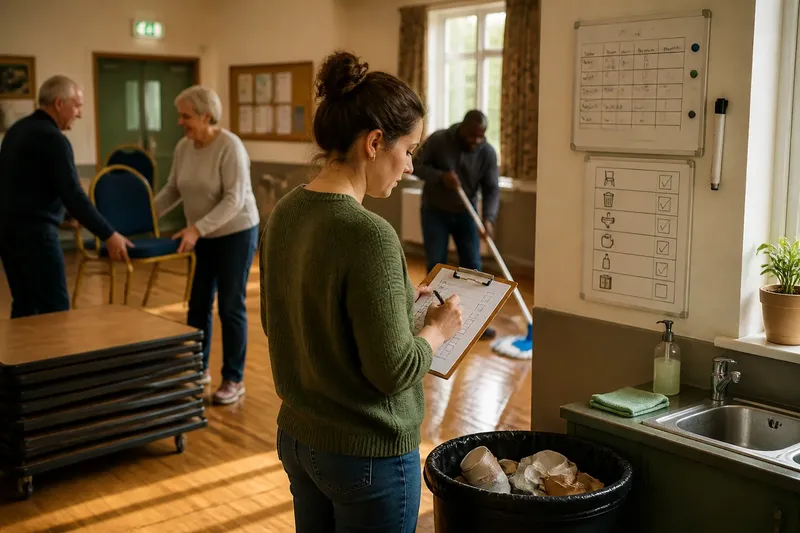
The folding tables are stacked, the sink is clear, and a bin is nearly full after a busy evening at the community room. A task rota or shared checklist can make the next decision easier: who takes care of the bin, and how will anyone know it needs attention? The best routine is not necessarily the tidiest-looking sheet. It is the one people can use without guessing, chasing, or quietly carrying all the work.
A rota assigns responsibility to named people or roles. A shared checklist records the work that needs doing, leaving people to claim or complete tasks as they arise. A third option—a rota paired with a short checklist—can connect clear ownership with a record of what remains. Each approach has strengths, and each can become burdensome if it asks more of the group than its ordinary habits can support.
A rota works when ownership needs to be clear
A rota answers a direct question: who is responsible for this task during this period? That can help when a facility has recurring jobs that cannot be left to chance, such as setting out chairs before a regular gathering, checking that shared supplies are put away, or arranging a handover between groups using the same kitchen.
Rota duties can be assigned to a person, a team, or a role. A named volunteer may suit a small group where people know one another and can easily trade duties. A role such as “closing pair” may be more robust when membership changes, since the responsibility stays attached to a function rather than one individual. The rota should make clear what the assignment covers and how someone can ask for a swap.
The main benefit is visible ownership. If the room is booked for a regular activity, a rota can connect preparation and closing tasks to the people already organizing that session. The arrangement is especially useful when a task has a clear time window or depends on someone having access to the space.
Its weakness is that an assignment can be mistaken for proof of completion. A person may be away, a gathering may run late, or a task may not be needed. If nobody can see whether the work happened or how to handle a missed turn, a rota can create awkward follow-up instead of dependable care. A simple swap method and a way to mark completion help the schedule stay practical.
A shared checklist works when needs change from day to day
A shared checklist records the condition or work to notice, rather than assigning every item in advance. It might include “replace the paper towels if low,” “return folding chairs to the storage area,” or “tell the room coordinator if a cupboard latch is loose.” People who are present can see what needs attention and respond within their ability.
This format suits places with irregular use, shifting attendance, or tasks whose timing depends on what has happened. A craft session may leave different materials to put away than a neighborhood meeting. A shared list can capture those differences without making someone responsible for a fixed set of jobs every time.
Checklist wording matters. “Keep the kitchen clean” is open to interpretation; “wipe the counter after food preparation” is easier to understand and mark. Keep entries within the group’s agreed scope, and separate routine tidying from issues that should be reported to a coordinator or handled by a qualified worker. The checklist is for ordinary shared care, not a substitute for a formal maintenance process.
The risk is that a list of unassigned tasks becomes a list everyone assumes someone else will handle. It can also grow into a record of every minor imperfection, discouraging people from using it. Limit the list to useful, observable actions; provide a clear place to report a concern that cannot be addressed during an ordinary visit.
A rota with a checklist can connect ownership and follow-through
Some groups need both an assigned turn and a record of what happened. In a combined routine, the rota names who is coordinating care for a session or period, while the checklist shows the relevant tasks and their status. The person on duty does not necessarily do every job. They make sure the list is visible, invite others to share suitable tasks, and pass along anything that remains unresolved.
This approach can suit a facility shared by several groups, especially when one group’s use affects the next group’s setup. It also gives a coordinator a better handover without requiring a detailed account of every visit. But the added structure only helps if the group understands who updates the record and what happens when an item is unfinished.
Imagine a community hall used by a weekday lunch group and an evening class. The hall team could assign a closing coordinator for each lunch session and keep a short checklist for chairs, food-area tidying, and supplies that need replenishing. If the coordinator notices a loose cupboard handle, they can record it for the facility contact rather than treating it as an ordinary checklist job. The expected observable result is a clearer handover: the evening class can see what was completed and what needs follow-up.
A hybrid should stay small. If it requires a detailed log, multiple signatures, and separate records for routine tasks, people may spend more effort maintaining the system than caring for the space. A brief rota and a few meaningful checklist items are usually easier to keep current than an elaborate tracking arrangement.
Choose the routine by looking at how work actually arrives
Before choosing a format, talk through a normal week in the facility. When does care happen? Which tasks must happen at a particular time? Which ones depend on the group that has just used the room? Who can take responsibility, and who needs an easy way to notice or report a problem without taking on a standing duty?
Then compare the options against the group’s real habits:
- Choose a rota when recurring tasks need a clear owner and people can reliably cover assigned turns.
- Choose a shared checklist when work varies with use and many visitors can notice or complete small tasks.
- Choose a rota with a checklist when a named person should coordinate a handover but tasks still vary from session to session.
- Keep the routine informal when the space is used by a small, consistent group and a written system would add needless administration.
Pay attention to the difference between “someone is responsible” and “someone must do everything.” A workable arrangement can assign responsibility for noticing, coordinating, or reporting without making one volunteer the default caretaker of the whole facility. Discuss what participants can reasonably contribute, and make it acceptable to decline or request a change.
It is not worth the effort to track tiny actions that nobody uses to make a decision. A separate mark for every chair moved, cup washed, or light switched off can turn ordinary consideration into paperwork. Record only what helps the next person act, helps the group share work fairly, or identifies a concern that needs follow-up.
What should a useful care routine make clear?
Who updates a shared checklist?
Choose a person or role that is already present during the relevant activity, and say whether they mark completed items or only add concerns. If everyone can contribute, agree on where the current list lives so people are not relying on an old copy.
What belongs on a rota?
Include repeatable tasks with a clear time or occasion, such as preparing the room for a regular booking. Keep duties specific enough that the assigned person knows what they are taking on, and provide a straightforward way to arrange a swap.
What should happen when a task is missed?
Make the next action clear: leave the item visible for the next group, contact the coordinator, or reschedule it through the usual facility process. The response should fit the task; a missed routine job and a concern requiring professional attention do not belong in the same follow-up path.
How can a group tell if its routine is too complicated?
Notice whether people can explain how to use it without a long introduction and whether the record stays current. If entries are routinely skipped or nobody knows who follows up, simplify the system and ask the people using the space what would help.
Review the routine without turning it into another burden
A care routine should adapt as bookings, volunteers, and facility needs change. Ask users whether responsibilities are clear, whether checklist items still matter, and whether the handover tells the next group what it needs to know. Remove duties that no longer apply; add an item only when an actual gap calls for it.
For shared care in a community space, the choice between a task rota and shared checklist comes down to where the group needs clarity: ownership, visibility, or both. Start with the lightest routine that addresses that need. Make the record easy to find, make changes easy to request, and keep a separate route for repairs or concerns that fall outside ordinary volunteer care. That leaves people with a usable agreement—and more attention for the place itself.