Neat Is Not the Same as Easy to Use
Make a shared space easier to use by placing everyday items where people expect them, labeling clearly, and leaving room for different activities.
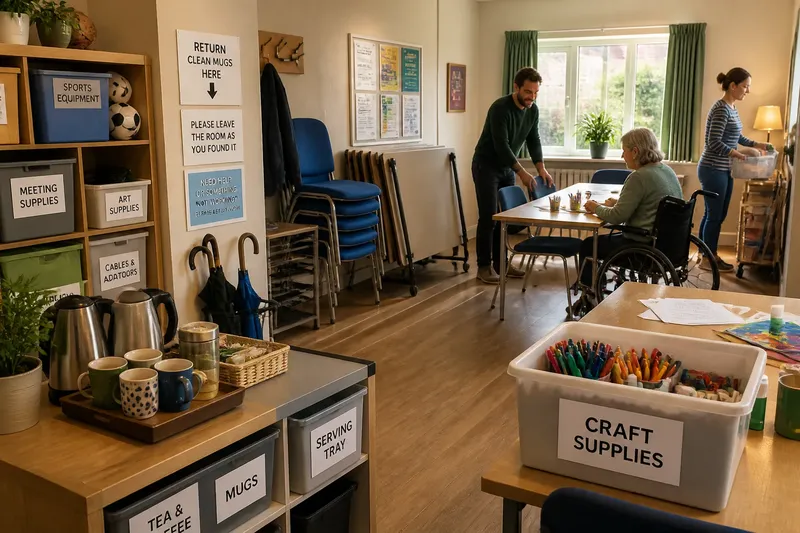
A stack of chairs sits squarely against the wall, the pens line up beside the sign-in sheet, and every shelf looks orderly. Yet a visitor still has to ask where to put a wet umbrella or whether the folding table is available. Making a shared space easy to use takes more than tidying it; it takes choices that make sense to people arriving with different needs and plans.
The useful question is not whether a room looks uniform. It is whether someone can find what they need, understand what a label means, and use the space without having to undo someone else’s arrangement. Work through the room in that order: observe how it is used, establish clear homes for common items, make labels answer real questions, then leave space for uses that do not happen every day.
Start with the room in use
Look at the space during an ordinary activity, not only after it has been cleaned. A polished room with no one in it can hide the decisions that make it awkward. Notice which items people retrieve, where they pause, and what they move before they can begin.
Watch for small signals. Do people open several cupboards to find the tea tray? Do they leave sports equipment beside the door because its storage place is unclear? Does someone shift a table to reach an outlet or create room for a wheelchair? These observations are about the arrangement, not the habits of particular people.
Ask users a few direct questions while the details are fresh: “What did you need that you couldn’t find?” “Where do you usually put this away?” “What do you have to move before you can start?” A person who uses the room regularly may not notice a confusing label, while a new visitor may spot it at once. Hear both perspectives before changing the layout.
Keep the first pass simple. A short list of repeated snags is more useful than a broad judgment that the room feels cluttered. Record the item, the place where it was sought, and what happened next. That gives the group a practical starting point without treating every difference in taste as a problem.
Give everyday items clear homes
Choose a location by considering who uses an item, how often it is needed, and what must be nearby. Pens belong close to the forms that require them. A kettle’s mugs, tea, and serving tray should be easy to gather without searching across the room. Equipment used for a recurring activity can live together, provided its storage does not block a shared area.
Prefer a location people can reach and recognize over one that makes a shelf look balanced. Heavy or frequently used items should not be placed where users must stretch, crouch, or move several other objects to get them. Keep commonly needed supplies visible enough to identify, but not spread across work surfaces where they become obstacles.
Before relocating anything, check whether the current place serves someone whose use is less visible. A low shelf may be easier for a seated person to reach. A clear patch beside a table may be needed for mobility equipment, even if it looks unused between activities. Ask people who rely on the space rather than assuming that an empty area has no purpose.
Say a community room keeps art supplies in a cupboard across from the tables, while paper and glue are scattered in separate drawers. Imagine the group moving the frequently used materials into a labeled, reachable bin beside the work area and leaving less-used supplies in the cupboard. During the next craft session, participants can gather what they need in one place, while the clear tabletop remains available for the activity.
Write labels that answer a question
A label helps when it tells someone what is inside, where something belongs, or what to do with it. “Craft supplies” is more useful than “Miscellaneous.” “Return clean mugs here” gives a clear destination and condition. Use familiar words, and make the text readable from the place where a person has to decide.
Keep labels specific without turning them into paragraphs. If a bin holds markers, name markers. If it holds several kinds of materials, list the main contents or use a category that users already understand. A label that describes an ideal arrangement but does not match the contents will quickly lose credibility.
Use words as the primary cue. Color can distinguish categories, but it should support the label rather than replace it. People may not recognize the color scheme, and some may not distinguish colors in the same way. Consistent wording across a cupboard and its bins also reduces the need to decode a new system each time.
Make temporary instructions easy to remove. A paper sign taped over an old label can leave two conflicting messages. When a use changes, update the permanent label and take down the temporary one. If the room is shared by groups with different terms for the same equipment, choose language they can agree on or add a familiar alternative.
Leave room for uses that vary
Not every object needs a permanent place that dictates how the room must look. A room may host a meeting in the morning and a repair group later. A large table arrangement that suits one activity can make another difficult. Instead of arranging everything for a single ideal scene, distinguish between fixed needs and adaptable choices.
Keep essential access and shared facilities clear, then make movable furniture easy to identify and return. A simple floor plan posted inside a storage cupboard can show a preferred arrangement without insisting that every gathering use it. If furniture is heavy or difficult to handle, do not make moving it part of an unspoken expectation; ask users what arrangement is workable and who can help.
Consider whether an item is genuinely needed in the room at all times. A decorative display may make the room feel finished, but it should not take the only useful surface or make a flexible area difficult to set up. It is not worth the effort to make every shelf match, buy containers simply because they look coordinated, or hide useful objects to maintain a photograph-ready room. Spend attention on decisions that make use clearer and easier.
Be cautious about removing an object because it seems out of place. A spare chair, a portable lamp, or a small side table may support a less common activity or a user’s particular preference. Ask who uses it and whether it has a practical role. If nobody can identify a purpose, consider storing it somewhere it can be found again before disposing of it.
Check the arrangement with real questions
Once the room has been rearranged and labeled, walk through it as someone arriving to do a familiar task. Look for the place where the task begins, the tools it requires, and the location for putting them away. Then ask people who use the room in different ways to try the same walk-through and point out any unclear choices.
Use concrete prompts rather than asking if the room looks better:
- Can a new user identify where the shared materials are kept?
- Does each label describe what is actually in its container or cupboard?
- Can people reach frequently used items without moving unrelated supplies?
- Is there space to adapt the furniture for more than one activity?
- Can a person tell where borrowed items should go when finished?
- Are useful objects preserved even when they are not part of the usual setup?
When an answer reveals a snag, change one thing at a time where practical. A cupboard that is difficult to scan may need clearer labels, not a wholesale redesign. A table that blocks a less-used activity may need a more flexible arrangement rather than removal. Small adjustments make it easier to see which decision actually helped.
Which changes matter most to users?
Should every item have one permanent place?
Give frequently used items a dependable home so people do not have to search. Less common equipment can have a known storage area without being fixed in place if different groups need it for different activities.
Are matching containers worth buying?
Only if the existing containers make items hard to identify or store. Clear names and reachable placement matter more than a matching set, so reuse sound bins and boxes when they serve the purpose.
What should happen when groups disagree about a room’s setup?
Separate shared needs from preferences, then look for an arrangement that preserves essential access and supports more than one activity. If a decision affects a particular group’s ability to use the room, ask its members before settling the arrangement.
How can the group tell whether a change is working?
Listen for fewer repeated questions and notice whether people can find, use, and return the relevant items without interrupting others. If confusion continues, revisit the location or wording rather than assuming users simply need to learn the system.
Keep the room understandable as it changes
A useful arrangement can drift as equipment arrives, groups change, or a label stops matching its contents. Agree on who can update a label or move a shared item, and make it easy for users to raise a concern. That does not require a formal process; a note to the room’s regular organizers can be enough if someone responds.
When a new activity needs space, check how it affects the room’s other uses before making a permanent change. Move items only when their new home is clear, and tell regular users when the location has changed. If the new setup creates a barrier, adjust it rather than asking every user to work around it.
For a shared space, a tidy appearance is only useful when it helps people understand what is available and how to use it. Clear homes, accurate labels, and room to adapt make that possible without forcing every activity into the same arrangement. The best sign that the room is easier to use is not that everything looks identical; it is that more people can begin what they came to do without first having to solve the room.